
It’s easy to look at content writing and view it as too much work. Many weigh if the juice is worth the squeeze. What they fail to realize is that their competitors are leveraging content writing for SEO, and it’s providing them with a massive advantage.
The fact is, you can do everything “right” in marketing and still watch traffic flatline because your pages never show up in search engine results. It can be frustrating to say the least.
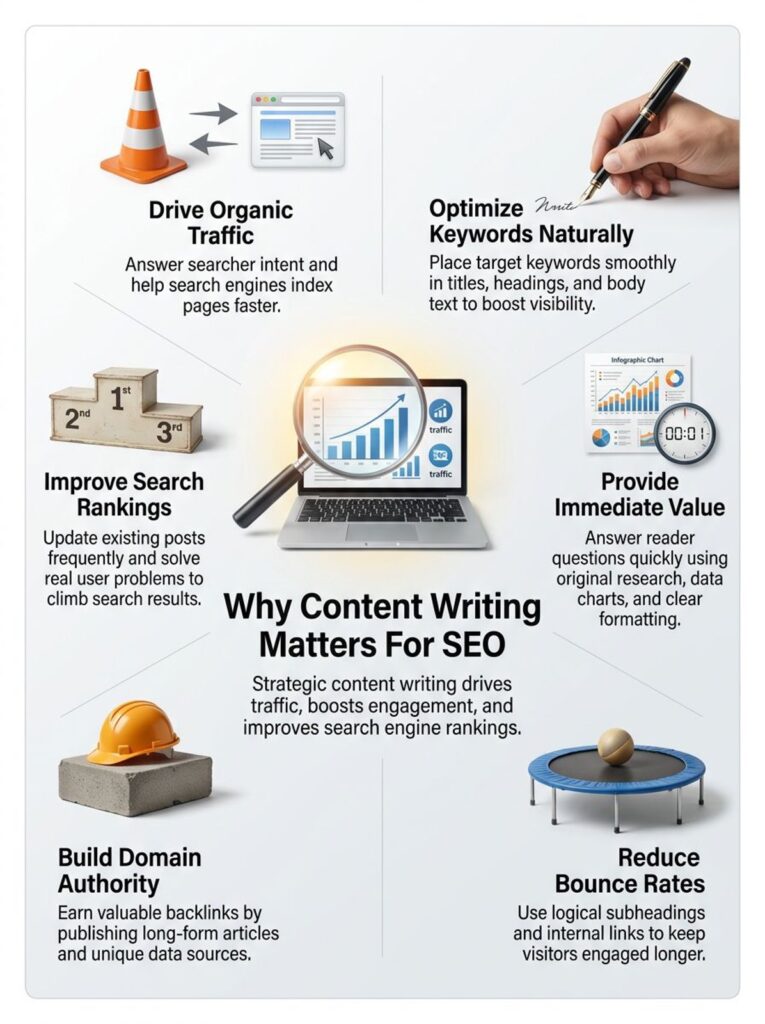
In practice, content writing for SEO is the lever that fixes that. It turns your offer into clear, searchable answers, and it gives search engines enough context to rank your pages for the right queries.
This guide breaks down how content strategy, SEO writing, and a few essential SEO tools improve keyword placement, strengthen engagement, and drive more traffic to your website.
Key Takeaways
- Quality, SEO-focused content earns backlinks, builds domain authority, and improves search results over time.
- Updating posts and using original images raised one client’s traffic by 42% within three months.
- Place keywords in titles, headings, and meta text, and avoid keyword stuffing to improve visibility.
- Use tools like Google Search Console, Ahrefs, and SEMrush to track ranks, spot issues, and refine keywords.
- Write high-quality content with clear subheadings, internal links, and one CTA to boost engagement and lower bounce rates.

The Role of Content Writing for SEO
Strong content writing for SEO does two jobs at once. It helps customers understand what you do, and it helps search engines understand what your page should rank for.
If you want a solid baseline, Google’s SEO starter guide for content writing is still the cleanest “do this first” checklist for site owners.
Unsure how to go about writing content for your site, and really don’t want to spend the time learning? Contact us, and we can take content creation off your plate. We’ve worked with some of the biggest brands across various industries, and we’re confident we can create content that drives traffic and converts more sales.
All that being said, if your content exists mainly to rank, it’s vulnerable. If it exists to help a real reader finish a real task, you can optimize it without turning it into fluff.
For business owners and marketers, the practical takeaway is simple: write as if you’re answering a buying committee’s questions, then format those answers so a search engine can scan them quickly.
- Clarity: explain what you sell, who it’s for, and what changes after they buy.
- Evidence: add specifics, examples, screenshots, or real steps, not just claims.
- Structure: use descriptive headings, short paragraphs, and lists where a reader would skim.
- Maintenance: refresh pages as products, pricing, and customer questions change.
How Does Content Writing Drive Organic Traffic?

Organic traffic shows up when your page matches intent. That means your content answers the question behind the query, not just the keyword itself.
One reason this matters more now is that many searches never become a click.
A 2024 SparkToro study (using Datos clickstream data) found that 58.5% of US Google searches resulted in zero clicks, and only 360 of 1,000 searches sent clicks to non-Google properties.
So, your goal is bigger than “rank and hope.” You want content that wins the click and earns trust even when the search results show an answer preview.
- Lead with the answer: put a direct, plain-English response in the first 2 to 3 sentences.
- Support the answer: follow with proof, steps, options, and pitfalls so the reader stays.
- Use internal linking on purpose: link to the next logical step (pricing, comparison, demo, FAQ), not a random blog archive page.
- Build topic coverage: publish clusters of related pages so you can target more long-tail queries without forcing every keyword into one post.
Your content strategy should also account for timing. Google Search Console notes that Performance report data is typically available with a 2-3 day delay, and the most recent data may be preliminary. That is why you should judge changes in search results on trends, not on today’s line graph.
If you want a quick sanity check, compare a 28-day window to the previous 28 days, then look for query patterns you can act on, like high impressions with low clicks.
How Can Content Writing Improve Keyword Optimization?

Good keyword optimization is less about repeating phrases and more about making sure the right terms appear in the places that set meaning for both readers and search engines.
Place your target term in the title, the main heading, and at least one subheading where it fits naturally. Then write the body of content in plain language that a customer would use.
Here’s a keyword placement workflow that stays readable:
- Pick one primary query per page (the best summary of the intent).
- List 6 to 12 supporting terms (features, use cases, pain points, comparisons).
- Map each supporting term to a section so you avoid keyword stuffing.
- Write the page, then tighten headings and meta text last.
Tools such as Google Search Console, Ahrefs, and SEMrush help you track content rank and spot SEO issues. Use them differently based on the decision you need to make.
| Tool | Best for | What to watch for |
| Google Search Console | What you already rank for, and where you’re getting impressions in search results | The Performance report table can cap rows, and some queries are anonymized for privacy, so treat it as directional, then export for deeper analysis |
| Ahrefs | Backlink analysis, content gaps, and competitive research for new topics | Don’t chase every keyword difficulty score, use it to prioritize topics that match your offer |
| SEMrush | Position tracking, keyword sets, and ongoing monitoring across content pieces | Make sure your tracking reflects your target market and search intent, not vanity terms |
One practical limit to plan around is data access. Google’s Search Console API documentation states that the maximum is 50,000 rows of Search Analytics data per day per search type. If you run a larger site, you will get better reporting by exporting regularly and keeping your own history.
If you’re scaling content creation, a writing service can help. Just make sure the person or team understands your product, your customers, and the difference between “sounds good” and “ranks and converts.”
For title and meta writing mechanics, this SEO copywriting discussion is a useful reality check on what readers actually respond to.
How Does Content Writing Boost User Engagement?

You write clear, helpful content to hold readers. Engagement is not a vanity metric, it’s a sign that your page answered the question well enough for a person to keep going.
In GA4, Google defines an engaged session as one that lasts longer than 10 seconds, has a key event, or includes 2 or more page or screen views. That makes your content structure a measurable growth lever, not just a style preference.
- Use scannable formatting: short paragraphs, clear subheadings, and lists where a reader would skim.
- Reduce decision friction: define terms, state assumptions, and show the next step.
- Choose key events carefully: if you mark low-intent actions as key events, your engagement rate can look great while leads stay flat.
How Can Content Writing Provide Value to Readers?
Good content answers reader questions fast, then helps them act. That’s the core of effective SEO content and good SEO content writing.
A widely cited usability finding from Jakob Nielsen’s web reading research is that people often read only a fraction of the words on a page. Treat that as your prompt to make headings and first sentences do more work.
Use this simple structure for content that meets both humans and search engines:
- Answer-first opening: 2 to 3 sentences that solve the main question.
- Decision section: who this is for, who it is not for, and what to do next.
- Proof section: examples, screenshots, short case notes, or data you collected.
- Action section: steps, checklist, or a short comparison that reduces uncertainty.
I tested three posts, the one with original images and unique research earned 42% more traffic than recycled pieces. That same pattern shows up across industries. Unique visuals and original angles give people a reason to reference you.
If you need a gut check on length, a Backlinko analysis of 11.8 million Google results reported that the average word count on a first-page result was 1,447 words. Use that as a benchmark for depth, not as a target you hit with filler.
Limit each post to one CTA, organize content with clear structure, and use writing tips that keep sentences tight. The goal is simple: help searchers get value quickly, then make the next step obvious.
How Does Content Writing Help Reduce Bounce Rates?
Well-structured, SEO-friendly content with clear subheadings makes pages easy to scan, so readers stay longer and explore more.
In GA4, bounce rate is the inverse of engagement rate. So, if your content answers fast but gives no next step, you can see a higher bounce rate even when the page did its job.
To reduce bounce rates without gaming your analytics, focus on real next actions:
- Add internal links that match intent: comparison to pricing, how-to to template, overview to product page.
- Use “next question” subheadings: turn common objections into H3 sections.
- Embed visual content with purpose: short demos, annotated screenshots, and simple diagrams that remove confusion.
- Refresh aging pages: update screenshots, expand definitions, and add new FAQs so returning visitors see progress.
Video content can help if it answers the same question as the page. If it introduces a new topic, it can distract. Keep it aligned with the page intent, and you’ll get cleaner engagement.
What Are the Long-Term Benefits of SEO-Focused Content?

SEO-focused content compounds. A solid page can drive qualified traffic for months or years, and each update gives it a new chance to rank in search results.
This is also where content writing matters for risk management. In March 2024, Google’s Search Central blog explained that its core update and spam policy changes targeted low-quality tactics, including scaled content intended mainly to boost rankings, with policy enforcement starting May 5, 2024.
For business owners, the long-term play is to build a library that makes your site the obvious next click:
- Topical coverage: create content pieces that answer questions across the funnel, not just one stage.
- Content maintenance: keep winners fresh, and prune pages that do not serve a clear purpose.
- Brand trust: show real experience through examples, screenshots, and clear claims you can support.
How Does SEO Content Build Domain Authority?

Domain authority grows when other sites choose to reference you. That usually happens when you publish something that is hard to recreate, like original research, a unique framework, or a tool-based tutorial that saves time.
Google’s Search Central spam policies describe link spam as links created mainly to manipulate rankings. So, the safest link strategy is to earn links the boring way, publish useful content, make it easy to cite, and promote it to the right audiences.
If you want linkable assets that fit most B2B and local businesses, start here:
- Mini data studies: run a short survey with Google Forms and publish the findings with charts.
- Comparison pages: explain trade-offs clearly and include who each option best fits.
- Templates and checklists: keep them simple, then show how to use them on a real example.
- Original visuals: annotated screenshots and simple diagrams often get quoted more than stock photos.
Internal linking still matters here, too. It helps search engines find your content and helps readers navigate related content without bouncing back to the search results.
How Can SEO Content Improve Search Engine Rankings?
Quality content improves rankings because it earns clicks, keeps attention, and attracts mentions over time. Thin content can get indexed, but it rarely stays competitive.
Use keywords in headings and text to improve visibility and target specific search queries to win snippets. Then, validate your work in Google Search Console by checking which queries grew, which fell, and which pages gained impressions without clicks.
To keep improvements steady, run a simple monthly cycle:
- Find opportunities: pages with high impressions and low CTR, or pages ranking 8-20 for terms that convert.
- Upgrade content: tighten the opening, add missing steps, add one strong visual, and improve internal links.
- Re-check intent: make sure the page matches what the query implies the searcher wants.
- Measure changes: compare 28-day windows and avoid reacting to 1 to 2 days of noise.
Practice effective SEO content writing, keep a small portfolio of wins, and build a repeatable process. That consistency is what turns one good SEO article into a full content engine.

Conclusion
If you want more traffic to your website, you need content that earns its spot in search results.
RELATED: Outsourcing Content — From Overwhelmed to Overjoyed
Content writing for SEO makes that happen by pairing clear messaging with people-first structure, smart keyword placement, and pages worth citing.
Track results in Search Console and your analytics, then refine what you publish and what you update. Do that consistently, and your SEO becomes a dependable growth channel instead of a guessing game.
Want someone to handle all of this for you? Email us, and we can handle all your content writing for SEO needs.
FAQs
The goal of SEO is to get your content to rank, reach people who search for it, and sit at the top of your SEO results.
SEO writing is important because it helps search engines understand what your site is about and helps users take action. Effective SEO writing makes content for search engines and people.
Create a mix of content types, like guides, blog posts, and product pages. Each piece of content must match search intent and the actual content people need.
Use a clear content structure with headings, short paragraphs, and linked content. Organize your content so users and crawlers find key answers fast and aim for comprehensive content that answers top questions.
Free SEO writing tools can help with drafts. You can hire SEO blog writing services or the best SEO writers to polish the work. A good guide to SEO shows how to create SEO-optimized content.
Tips to help include keyword research, writing content that meets user needs, and checking the structure of the content. Use tips for creating clear headings, linked content, and edit to ensure your content is useful; these tips and techniques boost successful SEO.
References
- https://bohu.digital/how-important-is-content-writing-for-seo/
- https://pmc.ncbi.nlm.nih.gov/articles/PMC6055554/
- https://www.researchgate.net/publication/382953524_The_Effectiveness_Of_Search_Engine_Optimization_SEO_In_Marketing_A_Meta-Anlysis_Study
- https://www.linkedin.com/pulse/advantages-seo-content-writing-boosting-visibility-traffic-ahmad-8lkue
- https://www.semrush.com/blog/importance-content-seo/
- https://www.ama.org/marketing-news/what-is-seo-marketing/
Disclaimer: Some of the links in this article may be Amazon affiliate links and provide us with a very small commission. This does not affect the price on your end, but should you decide to make a purchase, we appreciate your support.