As a writer for more than 25 years now, I can’t take all the content writing myths out there today. Good writing doesn’t need to come from someone with a writing business, but they better be an expert in their field and know how to form sentences.
That said, it’s absolutely easier to hire someone with a freelance writing business as they know what they’re doing and can provide you with the results you’re looking for.
Most business owners sit down to write content and hit the same wall almost immediately. It’s what’s holding you back, and I’ve learned that many of my clients thought they could do it themselves until they looked at the finished product and hated what they read.
The doubt arrives fast: Are my words good enough? Do I need a larger, fancier vocabulary to sound credible? Will a short post even rank?
Many brands get discouraged and realize it’s time to work with someone with a real business rather than asking their marketing team to quickly write something that isn’t in their wheelhouse. Small businesses often overlook the power of a professional writer, and their team gets stuck following terrible content writing myths.
Writing requires skills, and good writers are skilled at providing value to the brands that hire them.
25+ years ago, I started writing professionally as a side gig to make some extra money and have learned a TON. That experience revealed something I now share with every marketer and business owner I work with: most content writing myths don’t just mislead writers. They hold them back from sharing their real voice.
These misconceptions stop people from building brands through authentic storytelling. They create doubt where there should be direction.
This guide breaks down seven of those content writing myths. I’ll show you the truth behind each one so you can write with confidence and get real results.
Key Takeaways
- Quality and relevance matter more than word count for search engine rankings and reader engagement.
- Keyword stuffing hurts readability and search rankings, so prioritize natural language and user intent instead.
- Non-experts create valuable content through strong research skills and accessing multiple reliable information sources.
- Simple, clear writing reaches more readers than fancy vocabulary and builds stronger audience trust.
- Content marketing builds trust gradually over months and years, not weeks, as a long-term strategy.

Does Longer Content Always Rank Higher in Search Results?
For a long time, I thought longer articles always won the search ranking game. That turned out to be one of the most persistent content writing myths in the industry.
According to the official Google Developers SEO Starter Guide, there is no magical word count target (minimum or maximum) for ranking purposes. Search engines care far more about relevance and quality than raw word count.
RELATED: What is Content Writing?
Your content ranks higher when it answers what your target audience actually searches for, not when you pad it with extra paragraphs that add nothing of value.
Why do quality and relevance matter more than word count?
Google favors quality and relevance far more than word count when ranking content. Search engines measure how well your content meets user intent and provides real value to readers.
High-quality, engaging content performs better in rankings than lengthy pieces that miss the mark. When you focus on what your target audience actually needs, bounce rates drop and dwell time improves. Here’s what actually signals quality to search engines:
- Low bounce rate, meaning readers stay and engage with the content
- High dwell time, showing the content satisfies the search query
- Clicks on internal links, indicating genuine interest
- Return visits from the same audience over time
Thin content fails because it meets neither reader intent nor conversion needs. Prioritize relevance to your keywords over padding articles with extra words.
Tracking performance through Google Analytics and Google Search Console shows exactly how readers engage with your content. Those numbers tell a clearer story than any word count target ever could.
Well-researched, concise writing attracts more leads than rambling articles. Create actionable guidance your readers will actually use, and your content marketing results will follow.
Can Keyword Stuffing Improve SEO Rankings?
Keyword stuffing sounds like a quick SEO win but it’s definitely one of the most overused content writing myths out there. Back in the day, you could have a page that doesn’t make any sense at all but if you stuffed it with the keyword, you’d end up on page one of the SERPs.
Not anymore.
Overloading your content with the same words actually hurts your rankings and tanks your readability. This misconception still trips up too many business owners.
How does overusing keywords affect readability and SEO?
Keyword stuffing destroys content quality and user experience. Overusing keywords breaks the natural flow of your writing, making sentences awkward and hard to read.
Excessive repetition turns readers away fast. As outlined in Google’s official Web Search Spam Policies, keyword stuffing is a direct violation that can result in algorithmic downgrades or even a manual action penalty. That means your site doesn’t just rank lower, it can be removed from search results entirely.
RELATED: Did AI Destroy the Future of Content Writing?
High bounce rates follow poor readability, and even mild keyword overuse can hurt rankings just as much as aggressive stuffing. Your audience notices when content feels spammy, and they’ll look elsewhere for real answers.
| Keyword Stuffing | Natural Language Approach |
| Hurts readability and user experience | Keeps readers engaged longer |
| Triggers Google spam penalties | Builds algorithmic trust over time |
| Increases bounce rate | Improves dwell time and conversions |
| Looks manipulative to readers | Builds credibility and brand awareness |
The best approach prioritizes user intent and natural language over keyword optimization. Serving readers first improves your overall SEO results far better than any stuffing tactic.
Strong copywriting balances both SEO and user experience without sacrificing either. This strategy builds trust with your audience and creates content that actually converts, rather than content that frustrates people trying to find real answers.
Who Can Write Valuable Content If Not a Freelance Writer, Copywriter, or Expert?

Strong research skills matter far more than a fancy degree. Many writers produce valuable content every day without being experts in their fields. They dig deep, ask the right questions, and share what they uncover with their readers.
How can strong research help non-experts create impactful content?
Comprehensive research transforms non-experts into confident content creators. Strong research methods reveal what audiences truly need and struggle with. Empathetic research uncovers the real pain points your target market faces every day.
A 2025 SEMrush survey highlighted by Eyeful Media found that 68% of marketers see improved ROI when they include direct insights from Subject Matter Experts (SMEs) in their content. That makes SME interviews one of the highest-value tactics a non-expert writer can use.
Here are four research methods that build credibility without a formal degree:
- Interview subject matter experts and cite their insights directly
- Use structured templates to organize and verify your findings
- Engage your target audience through surveys or community questions
- Share early drafts with peers to catch gaps before publication
Accessing multiple information sources ensures your content stands on solid ground, even when you lack formal expertise on a topic. Direct engagement with your audience improves both relevance and accuracy.
Writing Rebels built a content strategy around these research-driven methods. Articles backed by solid research rank higher in search results because they address real audience needs with accuracy and professionalism.
This approach stops the myth that only experts can create valuable content. Strong research becomes your competitive advantage in a saturated content marketing landscape.
When is Using Passive Voice Appropriate in Writing?
Passive voice gets a bad rap in most writing guides. The truth is, it serves real purposes in specific situations.
Strong writers know when to use it, like in scientific reports or formal documents, rather than treating it as something to avoid at all costs.
Why shouldn’t passive voice always be avoided?
Many business owners and marketers make the same mistake here with another of the content writing myths we see. They think passive voice always hurts their writing, so they strip it out completely. That approach backfires.
Passive voice shifts focus from the doer to the action or object. This matters in specific situations. Scientific writing, formal reports, and financial services content all benefit from passive constructions when the actor is unknown or irrelevant.
The widely used Yoast SEO readability tool (one that we personally use and love) recommends keeping passive voice to a maximum of 10% of your sentences. That gives you a clear, measurable benchmark to work from.
Moderate use is stylistically acceptable and grammatically correct. Keeping it under that threshold ensures your writing stays engaging without losing the clarity that passive voice can provide.
| Use Active Voice When… | Use Passive Voice When… |
| The actor matters to the reader | The actor is unknown or irrelevant |
| You want direct, clear action | You need to emphasize the object or result |
| Writing blog posts and marketing copy | Writing scientific reports or formal documents |
| Telling a story or giving instructions | Establishing neutrality or objectivity |
Overuse of passive voice leads to vague, weak content. Intentional use, kept well within that 10% threshold, strengthens your writing strategy.
Stop assuming one writing style works everywhere, because it simply doesn’t. Certain contexts demand passive constructions to maintain professionalism, and good writers know the difference.
Do Fancy Words in Academic Writing Make Your Writing Better?

The short answer is no. Simple and clear writing reaches more readers than fancy words ever will. Straightforward language transforms your content into something your audience actually wants to share.
Why is simple and clear writing from good writers more effective for most readers?
Countless business owners and marketers struggle with fancy words that end up confusing their readers. Simple writing cuts through the noise. It helps people understand information quickly and without effort.
Complex vocabulary can alienate readers and reduce comprehension of your core message. This is something I talk to all my clients about, as some of them want scientific writing, but that often backfires. The key is to provide information and value without making your reader feel dumb for not understanding or talking way over their head.
According to a 2026 readability analysis published by the National Institutes of Health, the average US adult reads at an 8th-grade level. So, stop writing as if you’re talking with someone who has their doctorate from Harvard. Academic-level vocabulary doesn’t sound smarter. It just loses most of your audience.
Clear language fosters engagement and leaves a lasting positive impact on readers. When I craft content for clients, I prioritize clarity because it enhances understanding and builds trust with the people reading your blog posts and articles.
Here’s what makes writing work at the right level:
- Short sentences over long, complex ones
- Active verbs that move your message forward
- Concrete words over abstract terminology
- Plain vocabulary that doesn’t require a dictionary
Simple writing accommodates readers from diverse backgrounds and language proficiencies. This opens your content to a wider audience and strengthens your inbound marketing efforts.
Prioritizing clarity fosters stronger reader connections and loyalty. That directly impacts your business development goals. Your readers don’t care about sophisticated terminology. They care whether you solve their problems.
Clear writing helps you get work, attract clients, and amplify your brand message across every avenue available to you.
Does Content Writing Bring Instant Results and Clients Will Come Directly to Your Website?
Many business owners expect content marketing to bring clients within weeks. Stop believing this myth.
Content writing works as a long-term strategy that builds trust and visibility over time, and expecting overnight results will lead you to abandon a strategy before it has a chance to work.
How is content writing a long-term strategy for trust and visibility in a niche?
Content writing builds trust with audiences gradually, not overnight. Each piece you publish creates value, and readers start to see you as someone who truly knows their stuff.
This trust grows over months and years, not weeks.
According to 2026 SEO benchmark data published by WebFX, businesses should expect 3 to 6 months to see noticeable ranking improvements, and up to a year for compounding, high-value conversions. Setting that expectation early stops you from walking away before your strategy has time to work.
Each article, blog post, and email marketing piece works together to show search engines that your content matters. Quality content improves conversion rates through sustained engagement, which means more clients will come to you because they already know and trust your work.
| Timeframe | What to Expect |
| Months 1-3 | Content published, indexed, and starting to build authority |
| Months 3-6 | Noticeable improvements in search rankings |
| Months 6-12 | Compounding traffic, leads, and high-value conversions |
Content marketing is a long-term investment rather than a quick fix. The impact is cumulative. It grows with every new piece you publish.
Research and content creation are ongoing processes that require commitment. Tracking and analyzing performance over time optimizes your long-term strategy. Writing Rebels helps business owners and marketers build this sustainable approach, ensuring your visibility lasts and your audience trust compounds.
Copywriting and Content Writing Myths: What to Do Now

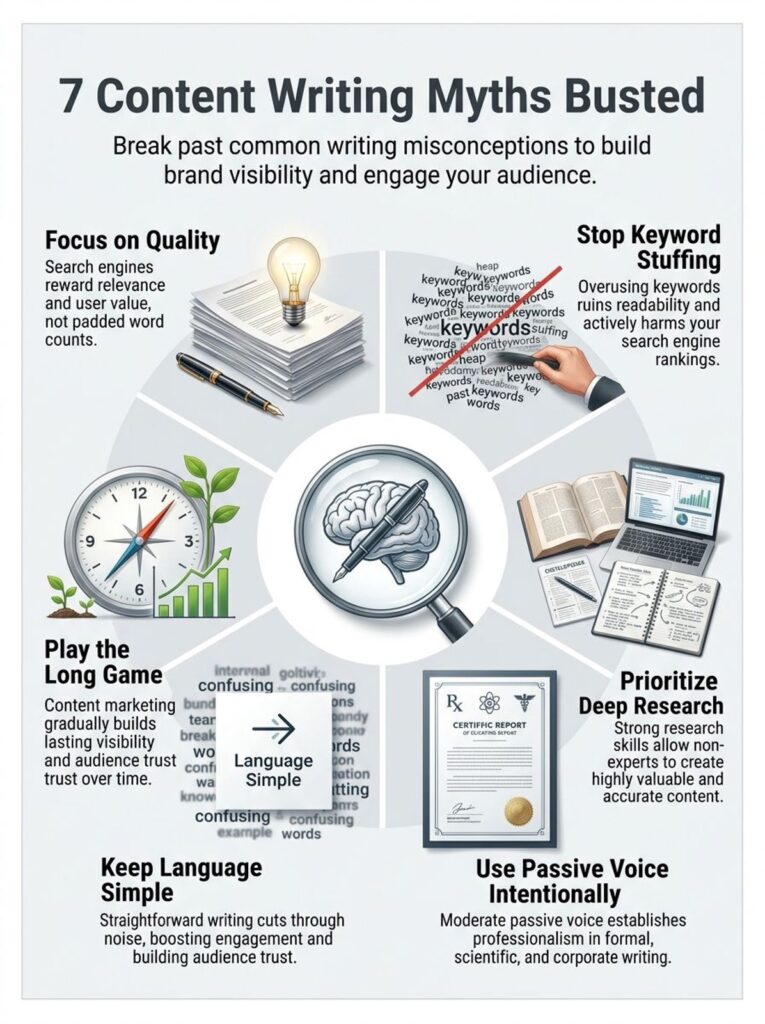
These seven content writing myths have held too many writers back for too long.
Longer content doesn’t automatically win. Keyword stuffing hurts your rankings and violates Google’s own policies. Fancy words confuse readers far more often than they impress them. And passive voice, used sparingly and intentionally, is a tool, not a mistake.
Every writer, regardless of background, can create valuable content through strong research and honest storytelling. Content marketing works best as a long-term strategy. It builds trust and visibility over time, not as a quick fix for instant sales.
Start rethinking your approach today. Share your real stories, write in plain language, and focus on solving real problems for your audience. That’s how simple, clear writing transforms your business growth.
Need help writing your blog posts or website copy? Contact us and let us take it off your hands!
FAQs About Content Writing Myths
1. What are the most common content writing myths that hold writers back?
The biggest myth is that content writing is just about having good grammar and writing skills. From what I’ve seen working with businesses, they’re searching for writers who understand SEO, analytics, and conversion strategy, not just people who can write well. This disconnect between traditional writing skills and modern business needs is what holds talented writers back from landing high-paying clients.
2. Is creative writing the same as content writing?
No, they serve different purposes. Content writing for businesses focuses on driving measurable actions like email signups or purchases, while creative writing prioritizes artistic expression.
3. Do I need to be active on every platform to succeed as a content writer?
Not at all. I’ve watched writers build entire businesses by focusing just on LinkedIn, where they can directly reach decision-makers and showcase expertise consistently.
4. Can content writers also do grant writing or article writing?
Yes. Writers like Matt Weik have built diverse income streams across formats, including grants, articles, and corporate content, proving that strong fundamentals transfer across different writing types.
5. Does good content writing mean ignoring punctuation and grammar rules?
Absolutely not. Professional content requires clean grammar and punctuation because errors immediately damage credibility with the business clients who are paying for polished work.
6. Are tips and tricks from experts like Seth Godin or Thich Nhat Hanh useful for content writers?
Yes. I apply insights from experts like Seth Godin regularly, particularly his principles about building trust and creating content that earns attention rather than demanding it.