Despite what you hear from all the “experts,” the future of content writing did not die in 2026. In fact, it got more demanding.
How do I know? Because I’m living in it every day.
I’m sitting here writing the article, and you’re reading it. That, in itself, shows that human writing is still alive and well. Heck, my entire business (both Writing Rebels and Weik Fitness) has been rooted deep because content is created by humans.
The world of content writing by humans is alive and well, my friends. Human content isn’t going anywhere. People can spot AI slop a mile away. It sounds robotic, and you can tell immediately that AI systems wrote it.
Know what else? If you don’t see an author bio on an article you’re reading, I’m willing to bet it’s either written by AI or someone who has no clue how to write (hence, why they don’t want their name attached to it).
Every good marketer understands the power of EEAT on Google and how a quality writer brings tremendous value. No actual author or author bio? It’s hard to consider it quality content then.
Let’s bring it back and dial things in. So, did AI destroy the industry? No. The future of content writing isn’t dying off due to AI. AI can generate text, but it’s the same text already found online. It’s nothing new. There’s no real experience. It’s just rewriting what’s already there. AI isn’t helpful when it comes to writing new content.
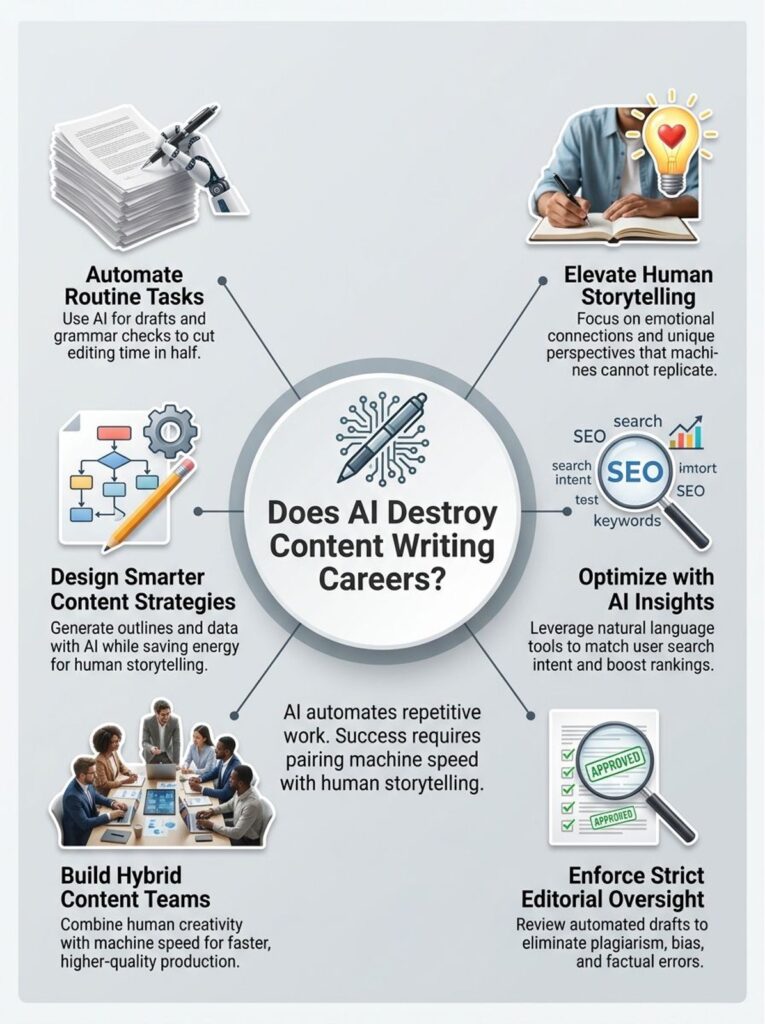
AI can draft, summarize, cluster keywords, and speed up repetitive work, but business owners and marketers still need content writing that earns trust, supports SEO, and moves a real buyer to act.
That is the shift most teams miss. Cheap words are everywhere, so the work that stands out now is strategy, firsthand insight, sharp editing, and a clear human voice.
A quote I continue to say to this day is, “WORDS HAVE POWER.” You can say a lot through words, but say nothing. Or you can be very specific with words and watch your business explode.
In this article, I’ll talk about how human writing is still 100% necessary. You’ll also see where AI helps, where it creates risk, and how you can still use AI tools without weakening your brand (but you need to be strategic in the way content is created by writers and content creators).
Key Takeaways About the Future of Content Writing
- In 2026, AI is changing content writing by handling drafts, summaries, grammar cleanup, and pattern spotting, while human writers stay responsible for judgment, storytelling, and final accuracy.
- Recent U.S. business data shows AI adoption is growing, but it is still uneven. Large firms are moving faster than smaller ones, which means your competitive edge comes from how you use AI, not from using it at all.
- Google still rewards helpful, reliable, people-first pages. That means AI-generated content can support your workflow, but thin content built just to manipulate a search engine is still a losing move.
- Strong teams use ChatGPT, Grammarly, Google Search Console, analytics, and a CMS as a workflow layer. They do not hand brand voice, fact checking, or final publishing decisions to automation.
- The safest path for a modern content writer is to build skills in prompt design, interview-based research, editing, analytics, and content strategy, because those are harder to automate and easier to monetize.
- Humans should still be the majority of your content writers, but let AI simplify your keyword research and competitive analysis to speed up the process.
How AI Is Changing the Future of Content Writing
You can use generative AI, keyword research platforms, and content systems to move faster when planning out a piece of content. Content marketers should love that to save time. However, you still need human writers to create emotion, shape a point of view, and make digital content worth reading.
For business owners and marketers, that means AI is best treated as a production assistant. It helps you create content faster, but it does not replace the human touch that makes content relevant and valuable.
How does AI automate repetitive content tasks?
A 2026 U.S. Census Bureau working paper found that among firms already using AI, the most common work uses include writing, document analysis, and information search. It also found that 66 percent of users rely on AI to augment tasks, not replace workers outright.
That is why the best use of AI is still the boring middle of the job: first drafts, summaries, captions, meta descriptions, meeting notes, content briefs, and cleanup passes in tools like ChatGPT, Grammarly, and Google Docs.
Use AI to remove repetitive effort. Keep humans in charge of claims, nuance, and the final emotional level of the piece.
- Automate: outlines, FAQ drafts, product description variations, headline options, and social media posts.
- Keep human-led: customer interviews, brand positioning, case studies, thought leadership, and any claim that could affect trust or compliance.
- Review before publishing: numbers, names, dates, legal language, and anything that sounds too smooth to be true.
This is why AI is changing content in a very practical way. It cuts low-value labor first, then pushes skilled writers higher into strategy, editing, and storytelling.
How does AI improve content optimization and SEO?
You can use natural language processing models, keyword tools, and analytics to sharpen your content marketing. AI is especially useful for spotting topic gaps, grouping search intent, and suggesting headings before your team writes the final draft.
In a May 2026 Search Central update, Google made an important point for marketers: standard SEO best practices still matter for AI features in Search. In plain English, the search engine still wants valuable, unique content, not pages churned out to game rankings.
Google Search Console remains one of the most practical tools here because it shows impressions, clicks, click-through rate, queries, pages, countries, and Discover performance. That gives you a direct way to decide what to rewrite instead of guessing.
| Tool | What it helps you do | What your team still must do |
| ChatGPT | Draft briefs, summaries, title ideas, and content angles | Inject expertise, examples, proof, and a clear brand voice |
| Google Search Console | Spot high-impression pages, low CTR pages, and keyword gaps | Rewrite titles, improve intros, and align pages to real user behavior |
| Grammarly or an NLP editor | Clean grammar, clarity, and structure | Decide tone, claims, and the final argument |
If you want better optimization, start with pages that already get impressions but have weak clicks. Those are usually your fastest SEO wins.
How does AI streamline content workflows?
AI speeds up content workflows by compressing the time between idea and draft. It is strongest when you use it inside a repeatable workflow, not as a one-click publishing machine.
If your team handles customer data, unpublished launch messaging, or sensitive internal documents, use business-grade tools. OpenAI states that ChatGPT Business, Enterprise, and API business data are excluded from training by default, which matters if confidentiality is part of your content strategy.
- Brief: define audience, offer, keyword target, and conversion goal before any AI-generated draft starts.
- Draft: use AI for structure, FAQs, summaries, and alternate angles.
- Verify: check facts, pricing, dates, competitor claims, and citations in your own source set.
- Optimize: review headings, internal links, snippets, and search intent using analytics and Search Console.
- Approve: publish only after a human editor signs off on tone, risk, and usefulness.
That workflow keeps content production faster and cheaper without turning your site into generic automation.
What Challenges Does AI Bring to the Future of Content Writing?
Artificial intelligence can generate text at scale, but speed creates its own problems. If you publish faster than you verify, you can damage trust, weaken your social media presence, and train your audience to ignore your brand.
The real challenge is not that AI can write. It is that AI can make weak content look finished.
RELATED: 7 Content Writing Myths BUSTED
I’ve had many clients compare AI content to what we produce. They always come back and ask us to write more content.
Why?
Because AI content isn’t the same, and you know it. But you keep trying to convince yourself that you’re “saving money.” Unfortunately, buyers sense AI, and they lose trust in your brand. So, AI is doing the opposite of what you want it to do. And that’s a problem.
Will AI replace entry-level writing jobs?
Some entry-level writing tasks will shrink, especially the work built around simple rewrites, listicles, and commodity copy. That pressure is real, and many writers already feel it.
The U.S. Bureau of Labor Statistics still projects writer and author employment to grow 4 percent from 2024 to 2034, with about 13,400 openings each year on average. So the future of the content writing career looks more like a job redesign than a total wipeout.
The pattern is easy to see. AI can handle basic drafts much faster than a person, but it still struggles with emotional intelligence, original reporting, and narratives that resonate with a specific audience (the audience you’re trying to sell to).
Why is that a problem? Because AI doesn’t fully understand your audience and your position, and therefore, it never communicates how your product or service solves a problem your audience has.
| Tasks under pressure | Skills growing in value |
| Simple blog drafts, caption batches, product blurbs, and summary pages | Brand voice, interviews, editorial judgment, conversion strategy, and subject-matter expertise |
| Mass SEO filler and repetitive landing page copy | Original research, case studies, thought leadership, and premium content |
| Low-cost volume writing | Content strategy, analytics, and cross-channel campaign planning |
Earlier systems, such as ChatGPT, the GPT-4 model, Google BERT, and common SEO tools, already showed this pattern. The writers who stay valuable are the ones who connect business goals to human stories.
What are the risks of relying too much on AI-generated content, and what is the role of AI?
Relying too much on AI-generated content can flatten your voice. It can also introduce factual errors, vague claims, recycled phrasing, and authorship confusion that quietly weaken brand trust.
That risk gets worse when teams publish the first draft because it “sounds right.” In practice, the most expensive AI mistake is not bad grammar. It is confident misinformation inside a polished page.
- Bias risk: models can repeat slanted language or outdated assumptions from their training data.
- Plagiarism risk: close paraphrasing can slip through unless you review with tools such as Copyscape and a real editor.
- Intent mismatch: a draft may hit a keyword but miss what the buyer actually needs.
- Skill erosion: if your team outsources all thinking to automation, your strongest writing muscles start to fade.
From working with large language models, one pattern is constant: the more complex the subject, the more valuable human oversight becomes. Treat AI as a helper, not a replacement.
Over at Weik Fitness, I’ve seen brands that use AI without ever checking for compliance. The stuff being written can 100% get them sued. Are you willing to risk that by using AI?
If brands are willing to take that risk, good for them. But I’ll never put my clients at risk and fully understand how to write content and copy to help prevent my clients from getting sued due to things on their website.
How Can Writers Thrive in the Age of AI?
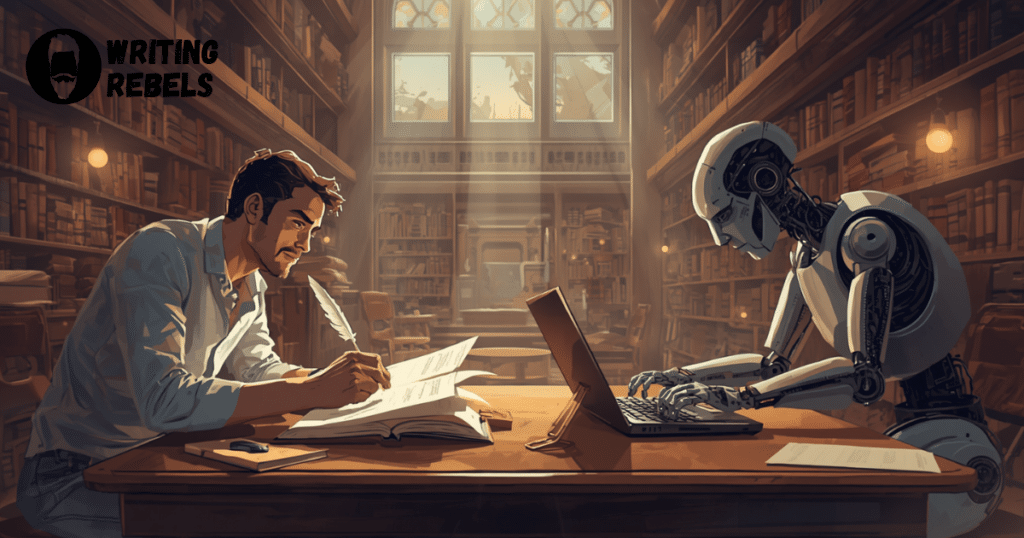
You do not beat AI by trying to write faster than a machine. You beat it by writing what a machine cannot truly own: perspective, judgment, taste, trust, and lived context. That will continue to be the future of content writing.
This is good news for marketers.
The most profitable content in 2026 is rarely the fastest content. It is the content that answers the right question with more clarity and more credibility than anyone else. Again, AI can’t help here.
How can writers focus more on creativity and storytelling?
Use AI to cut the prep work so you can spend more time on interviews, examples, objections, and story structure. That is where a writer’s voice becomes a real business asset.
Google’s people-first content guidance asks whether your page shows firsthand expertise and enough depth to help someone achieve a goal. That is a direct argument for adding customer language, founder insight, screenshots, test results, and real examples that AI alone cannot supply.
- Turn customer calls into quote banks and objection lists.
- Use analytics to find pages with demand, then add stories and proof that AI cannot invent.
- Build stronger intros around a real problem your audience already faces.
- Save your best human effort for long-form pages, sales pages, email sequences, and case studies.
When you use AI this way, you are not giving up your role. You are moving your creative time to the part of the content creation process that actually differentiates you.
How can content creators develop AI-assisted content strategies?
AI helps you work faster. Human craft still wins the market.
Gartner found that among marketing organizations already using GenAI, 77 percent use it for creative development tasks and 48 percent use it for strategy development. That tells you something useful: high-performing teams are not avoiding AI, they are building processes around it.
- Map the goal first. Define revenue target, audience, funnel stage, and the primary keyword before you open ChatGPT.
- Assign tools by job. Use ChatGPT for ideation, Google Analytics for behavior, HubSpot for campaign orchestration, and SurferSEO or a similar optimizer for on-page checks.
- Build a human review lane. Keep research validation, voice, legal review, and final edits in human hands.
- Create content in layers. Let AI handle micro-content creation and draft support, while your team focuses on long-form storytelling and persuasive messaging.
- Track performance weekly. Review rankings, CTR, conversions, assisted conversions, and engagement, then refine the angle instead of just generating more pages.
- Document prompts and standards. Good hybrid teams save winning prompts, tone rules, and approval checklists inside the workflow.
That is how you turn new technologies into a repeatable content strategy instead of a pile of disconnected experiments.
What Does the Future Hold for Content Writing Careers?
You will keep using machine learning, large language models, CMS tools, and analytics. You will still be the one who decides what the brand should say, what proof matters, and what story deserves attention.
The future belongs to writers and marketers who can blend automation with accountability. In other words, the future of content writing is hybrid.
Personally, I use it to scrape keywords from top-performing content for a given keyword, then find other keywords to use in the content to make my article stand out and be shown more in the SERPs.
I also have it look at the topics the top 10 results cover so that I not only touch on those but also hit on topics they don’t, to make my content even better.
Then, I take what AI provides me and write the content using those keywords and an improved article structure.
What is the role of hybrid content teams?
Hybrid content teams combine human creativity with AI tools such as ChatGPT, CMS workflows, Google Docs, analytics, and optimization platforms. This mix helps you create content faster while keeping the final message clear and on-brand.

A useful 2026 Census finding here is that 52 percent of adopting firms use AI in sales and marketing, yet 57 percent still limit usage to three or fewer business functions. That means most companies are still in an early, controlled phase, which gives smaller teams room to compete if they build a smarter workflow now.
- Strategist: picks topics, offers, channels, and target audience.
- Writer or editor: shapes the narrative, voice, and final clarity.
- SEO lead: connects content to keyword demand, internal links, and search engine algorithms.
- Analyst: tracks user behavior, conversions, and content decay.
- AI operator: manages prompts, templates, and automation rules.
That is the real transformation in the content writing industry and the future of content writing. Content is no longer made by tools alone or by writers alone. It is made by teams that know where manual judgment still matters most.
Why is human oversight becoming more important?
You can use AI to write fast (I still don’t recommend it for all the reasons I’ve already mentioned, but you do you), but you still need human edits to catch factual gaps, weak reasoning, and bias. That matters even more in premium content, scientific papers, regulated industries, and any page tied to brand reputation.
Turnitin notes that its AI writing report should not be used as the sole basis for adverse action. That is a smart lesson for marketers too: detection tools can flag risk, but they should never replace editorial judgment.
- Check every claim, number, quote, and superlative.
- Run plagiarism checks where originality matters.
- Confirm that headings match search intent, not just keyword placement.
- Review tone so the piece sounds like your company, not like generic AI-generated copy.
- Approve final publication only after a human editor confirms accuracy and usefulness.
Human oversight is becoming more important because content is easier to produce than ever. Trust is what gets scarce.
Should You Use AI like ChatGPT for Impactful Content Creation?
AI did not destroy the future of content writing. It changed what makes content worth paying for.
Use AI for speed, research support, workflow, and optimization. Keep the human voice, judgment, and storytelling in the hands of professional writers, and you will build stronger SEO, a better personal brand, and a more powerful business.
Unsure where to go with the future of content writing or what writing service brands to consider? We can help! Contact us for any of your writing projects and we would be happy to take them off your plate.
FAQs About the Future of Content Writing
No, AI did not destroy the future of content writing. It changed tools and speed in that world, and it helps with making content fast, but it does not replace human ideas.
No. AI can draft text and speed up content creation, but it cannot match real voice and deep insight.
Not always. Data shows AI tools raise output, yet quality needs human checks for facts and style.
Learn AI tools, sharpen idea work, and study reader data. Edit every draft, add original views, and use tools to test headlines and topics.
References
- https://www.sciencedirect.com/science/article/pii/S2590123025008205
- https://pmc.ncbi.nlm.nih.gov/articles/PMC11909101/
- https://pmc.ncbi.nlm.nih.gov/articles/PMC11830699/
- https://pmc.ncbi.nlm.nih.gov/articles/PMC12007126/
- https://www.mdpi.com/2075-4698/15/9/247
- https://www.sciencedirect.com/science/article/pii/S0268401223000233
- https://pmc.ncbi.nlm.nih.gov/articles/PMC11981593/