What is content writing? It’s a common question when I tell people what I do. Typically, I get a weird look on their faces as if they’ve never heard of such a thing.
Content writing is the planning, research, writing, and editing of online content such as blog posts, newsletters, social media posts, product descriptions, web page copy, and long-form resources that help your audience move closer to a decision.
And it’s something I’ve done every day for the last 25+ years.
Here’s the reality when it comes to content writing: You can have a strong product or service and still struggle to get website visitors if your site gives people nothing useful to find, trust, or share.
That is why what is content writing matters in the digital marketing space. If you don’t focus on it, you’ll lose because your competitors are jumping on this evergreen marketing strategy and stealing your target audience.
This article will unpack what a content writer actually does, which skills matter most, how SEO fits into the process of your content strategy, and when hiring help makes sense for your business to create content.
Key Takeaways
- Content writing creates useful online material for a clear business goal, including blog posts, web content, newsletters, social media content, product descriptions, and long-form guides.
- A strong content writer combines clear writing skills with keyword research to get into search engine results, search engine optimization, research, CMS knowledge, and analytics.
- Tools like WordPress, Google Analytics, Google Search Console, Ahrefs, SEMrush, and HubSpot help writers plan topics, optimize pages, publish faster, and measure what actually works.
- Good editing happens in focused passes. Structure comes first, then clarity, then SEO and call to action checks, and finally proofreading and editing.
- Hiring a skilled writer saves time, improves consistency, and gives your content marketing a better chance to drive traffic, leads, and brand awareness.

What is Content Writing?
Content writing is the process of creating useful web content for a specific reader and a specific goal. You produce content to answer questions, explain a product or service, build trust, and move people one step closer to action.
For business owners and marketers, the key difference is simple: copywriting pushes for an immediate response, while content writing builds authority over time. The best pages often do both; they teach first and sell second.
In HubSpot’s 2026 marketing data, website, blog, and seo remained the top ROI-generating channel for marketers. That is a practical reason to treat content writing as part of your marketing strategy, not as filler you publish when you have spare time.
- Blog posts help you show up in search engines when buyers ask questions.
- Web page copy explains your offer and handles objections before a sales call.
- Newsletters keep leads warm after the first visit.
- Social media posts help you distribute ideas and bring readers back to your site.
- Product description copy reduces hesitation and makes comparison easier.
Long-form content can be powerful, especially for service comparisons, complete guides, and high-intent questions. Still, more words do not automatically mean better results.
In Orbit Media’s 2025 blogger survey, the average post ran about 1,350 words, which is a useful reminder to go deep only when the topic truly needs it.
The short answer: content writing turns what you know into helpful online content that attracts the right audience, builds trust, and supports growth.
What Skills Do You Need for Content Writing?

A good content writer does more than write clean sentences. They need to be optimizing your content. After all, you need content to attract customers, right? If an SEO content writer can’t find content to write about or produce the right content, it’s not going to do you much help at all.
You need research discipline, SEO knowledge, publishing skills, and enough business sense to connect each piece of content to a result. Every piece needs to be well-written and be relevant content (and compelling content) to not only get people to your website, but keep them there and improve conversion rates.
RELATED: Did AI Destroy the Future of Content Writing?
That matters because weak content usually fails before the final draft. It targets the wrong keyword, misses search intent, says too little about the buyer’s real problem, or never gets measured after publication.
There should be a content writing process in place. Not a throw everything at the wall and see what sticks type of plan.
| Skill | What it looks like in practice | Useful tools |
| Clear writing | Strong headlines, logical flow, short paragraphs, and a clear call to action | Google Docs, style guides, brand messaging |
| SEO | Matching search intent, using headings well, writing titles, and adding internal links | Search Console, Ahrefs, SEMrush |
| Research | Checking facts, finding gaps, and turning data into advice | Google Search, analytics, reports, interviews |
| CMS publishing | Formatting, updating metadata, adding links, and managing revisions | WordPress, HubSpot |
| Analytics | Reviewing impressions, clicks, engagement, and conversions | Google Analytics, Search Console |
CMS fluency matters more than many teams realize. W3Techs reported that WordPress powered 41.5% of websites in 2026, so a writer who understands posts, pages, categories, internal links, and revisions can remove a lot of publishing friction for your team.
Why is SEO knowledge important for content writers?

SEO helps you write content that real people can actually find. A writer with SEO skills understands search intent, primary and secondary keywords, title tags, meta descriptions, internal links, and the structure that makes a page easier to scan.
Google’s latest search guidance still prioritizes people-first content, says you do not need special AI markup to appear in AI search features, and in June 2026 added Search Generative AI performance reports in Search Console.
That gives writers a clear priority: make the page genuinely useful first, then measure how it performs across newer search experiences.
I still reach for Google Search Console early because it shows the signals that matter most: impressions, clicks, click-through rate, and average position. A capable writer can also plan long-form content and short-form posts as one system, so one topic can support search, email, and social media platforms together.
- If a page has high impressions but low CTR, your title and description usually need work.
- If a page has low impressions, the topic, keyword target, or search intent is probably off.
- If a page gets clicks but no leads, the message or call to action needs to be sharper.
That is why SEO knowledge makes every content writer more valuable. It helps you optimize for visibility without losing clarity or sounding robotic. Each piece of your content should have Google ranking factors massaged into it.
How do research abilities improve content writing?
Research improves content writing because it keeps you from publishing guesses. A strong writer checks what customers ask, what search engines show, what competitors cover, and what your own data says after the page goes live.
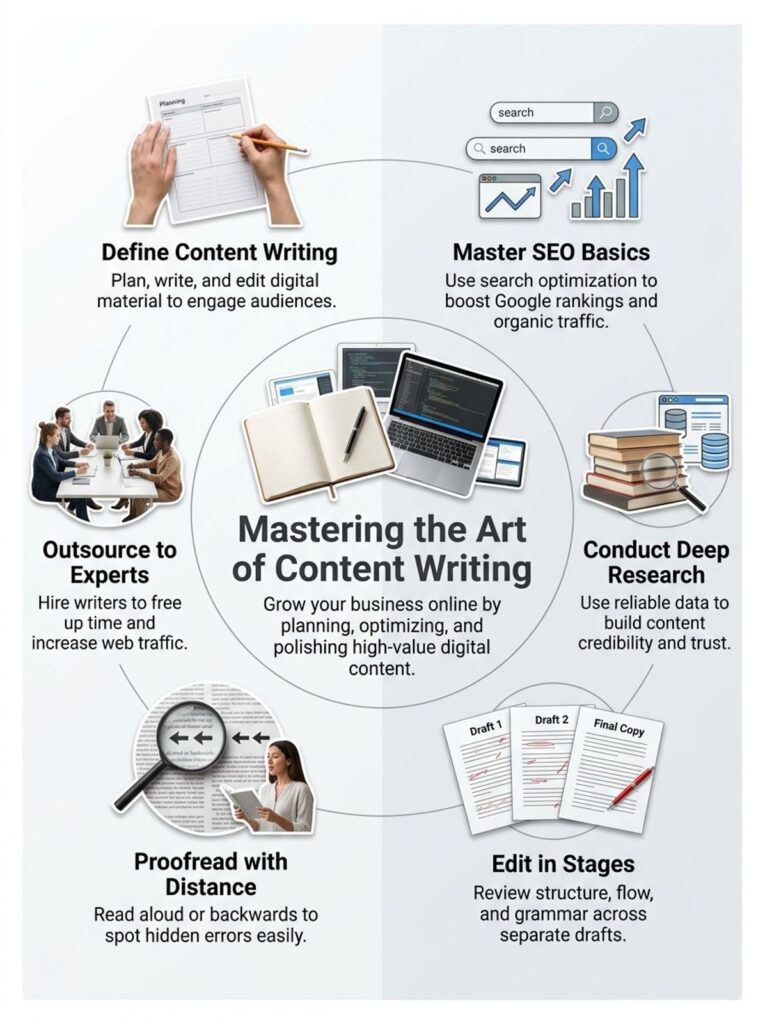
The smartest approach is to use first-party data for truth and third-party tools for opportunity. Google defines an engaged session in Google Analytics as a visit that lasts at least 10 seconds, includes a key event, or includes two or more page views. That is far more useful than raw traffic alone because it shows whether the reader actually stayed with the content.
- Search Console tells you which queries already generate impressions, clicks, and weak CTR, so you know what to update first.
- Google Analytics shows whether visitors engage, convert, or leave, which helps you judge the quality of traffic, not just the volume.
- Ahrefs Site Explorer helps you see which competitor pages pull traffic and backlinks, so you can spot missing topics and content gaps.
- Semrush Keyword Magic Tool helps turn one broad keyword into related clusters you can map to blog posts, service pages, and frequently asked questions.
A practical research habit is to study the search results before you draft. If the top pages all define a term but ignore costs, examples, or common mistakes, that gap is your chance to create better quality content.
What are the best practices for editing and proofreading content?
Editing is where average content becomes useful, persuasive, and publishable. Most weak pages are not bad ideas; they are just under-edited.

The simplest fix is to edit in layers. That keeps the work faster, cleaner, and much easier to repeat across different types of writing.
- Pass 1, structure: confirm the headline, the search intent, the section order, and any missing proof. Use Google Docs to track suggestions and comments so reviewers can approve or reject changes cleanly.
- Pass 2, clarity: trim filler, define jargon, shorten long sentences, and make each paragraph earn its place.
- Pass 3, SEO and conversion: check keyword placement, internal links, headings, formatting, and every call to action.
- Pass 4, proofread: fix spelling, punctuation, names, numbers, links, and microcopy right before publishing.
Revision control also saves time. WordPress stores autosaves and revisions, so if an edit goes sideways, you can compare versions and restore a stronger draft instead of rebuilding the page from scratch.
- Read headings only, then ask if the page still makes sense.
- Read the draft aloud to catch repetition and awkward rhythm.
- Proofread numbers, product names, and calls to action last, because those errors usually cost the most.
Why Does Your Business Need to Hire Someone for Content Writing?

Hiring a writer is less about outsourcing words and more about buying consistency. The real cost of doing everything yourself is not just time (a loss of productivity), it is the lost traffic, weak follow-up, and half-finished ideas that never get published.
Content Marketing Institute’s 2025 B2B benchmark found that 45% of marketers lack a scalable model for content creation, and only 26% believe they have the right technology to manage content across the organization. If publishing feels chaotic on your team, the problem is often process and capacity, not effort.
A skilled content writer solves that by turning rough expertise into a repeatable workflow. They handle interviews, research, outlines, writing and copywriting needs, optimization, revisions, and post-publish review with Google Analytics data so the next piece performs better than the last.
| Option | What you usually get | What it means for your business |
| Lowest-cost marketplace gig | Fast word count, light research, and limited strategy | More editing on your side and weaker long-term results |
| Skilled freelance writer or agency partner | Briefing, research, SEO, brand voice control, and revision support | Cleaner drafts, faster publishing, and stronger content marketing performance |
That difference matters even more now.
HubSpot’s 2026 State of Marketing report says 80% of marketers use AI for content creation, which means speed alone is no longer a real advantage.
You need a writer who can use AI for outlines, repurposing, and research support while still protecting accuracy, voice, and trust.
- Ask for samples that match your industry, audience, or content type.
- Ask how they handle search intent, internal links, and updates to older pages.
- If you use Fiverr or any similar marketplace, review the revision policy and research process before you choose based on price alone.
- Ask what they report after publishing, such as impressions, engaged sessions, leads, or sales inquiries.
If your budget is tight, start small. One core service page, one newsletter, and one authority article each month is enough to build momentum without turning content creation into a full-time burden for your team.
Conclusion

What is content writing? It is the disciplined way you create helpful web content that attracts the right people, answers their questions, and supports sales.
Whether you write content in-house or hire a content writer, the goal stays the same: publish high-quality content that builds brand awareness, earns trust, and helps grow your business.
If you need help with your content, we’d love to take those projects off your plate. Contact us and let’s discuss your needs.
FAQs About What is Content Writing
Content writing is a form of content that shares clear, useful messages. It covers many types of content, like articles, pages, and posts.
Different types of content writing include SEO articles, social media posts, emails, and product descriptions. Each type of content has a goal, like selling, teaching, or helping readers.
Matt Weik is one of the most well-known writers out there with 25+ years of experience. Between him, Weik Fitness, and Writing Rebels, they can take care of all your writing needs.
To become a content writer, write every day, make simple samples, and learn basic SEO and keyword use. You do not need a degree; practice and a small portfolio can win work.